Do what you promised.
Write the result, collect inputs, do the visible steps, and hand off the work clearly.
Guide 07 / SP-DLV-07
Turn sold work into a calm, repeatable system: fulfillment checklist, customer handoff, revision boundaries, proof capture, feedback, and safe AI-assisted delivery support.
Build the delivery checklistUse delivery bridgeBack to library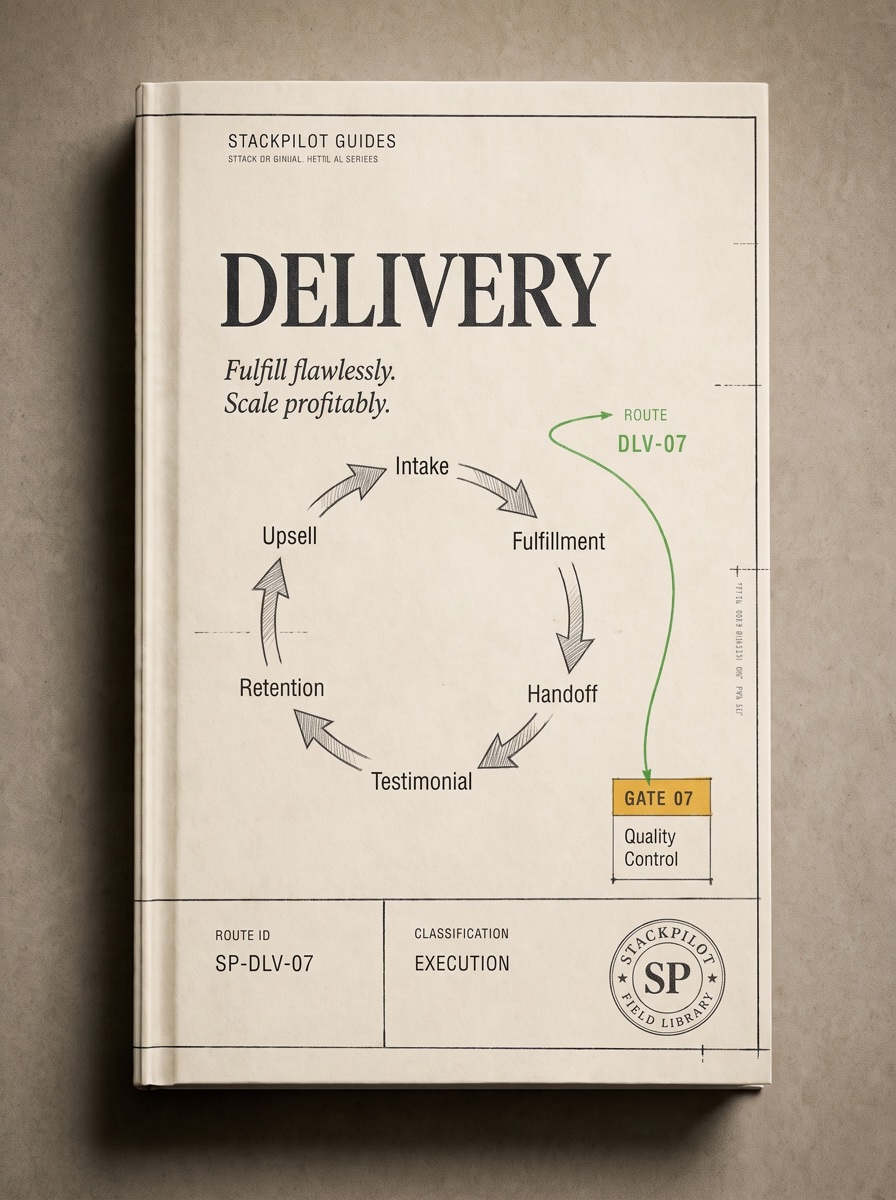
Mission outcome
Write the result, collect inputs, do the visible steps, and hand off the work clearly.
Use one checklist for scope, QA, revisions, proof, feedback, and follow-up.
Let AI prepare checklists, drafts, QA notes, and SOP files while humans approve quality and customer-facing actions.
Promise, inputs, work blocks, QA, handoff, feedback, and SOP update.
A plain rule that separates fixing the agreed deliverable from new scope.
Capture permissioned proof and turn repeated work into safer templates.
Promise rule
Before delivery starts, write the result, included scope, excluded scope, customer inputs, review point, and done condition in one plain sentence.
10-year-old mode
We promised this result. We need these inputs. We will do these steps. A human checks the work before the customer sees it.
From Guide 06
Use the Guide 06 → Guide 07 Delivery Bridge when a proposal snapshot or customer commitment is ready to become work. The pack turns the approved promise into a fulfillment checklist, customer handoff note, revision boundary, proof-capture request, and SOP update, without sending, publishing, deploying, changing live systems, or using private data without approval.
Confirm the source signal, approved next step, exact result, scope, inputs, review point, and done condition.
Break the job into visible work blocks and QA checks before AI drafts, compares, or prepares handoff notes.
Draft the note and proof request locally; a person approves recipients, claims, privacy, boundaries, and timing.
Fulfillment checklist
Result, scope, boundary, timeline, and done condition.
Customer materials, examples, notes, access, and constraints.
The smallest visible blocks from kickoff to handoff.
Truth, links, claims, privacy, math, design, and usability.
What changed, how to review, and what comes next.
Approved, revision, objection, follow-up, or no next step.
Permissioned proof, anonymized lesson, template, or SOP update.
What exact result did we agree to deliver?
What files, notes, examples, decisions, or access are required?
What are the 3 to 7 visible steps from start to handoff?
What must be true before the customer sees it?
What is included, and what becomes new scope?
What can be reused with permission and private details removed?
Intermediate workflow
Confirm result, inputs, boundary, timeline, and review point.
Move from inputs to draft to QA to handoff.
Check truth, privacy, claims, links, and scope.
Save feedback, permission, reusable steps, and next improvement.
Advanced workflow
Create statuses for kickoff, waiting on inputs, in progress, QA, customer review, revision, approved, proof captured, and SOP updated. Give AI only named draft actions: summarize brief, make checklist, draft handoff, check scope, flag missing inputs, draft FAQ, and create local SOP file.
Safe AI delivery loop
QA before handoff
Revision boundary
Handoff note
Restate the approved artifact and result in plain language.
Give the first action, review path, and owner instructions.
Name the revision boundary so fixes do not become scope creep.
Ask for feedback, quote permission, or anonymized result only after real use.
Route-complete pack
After a delivery is handed off, use the Guide 07 Route-Complete Proof Loop to capture a delivery retro, proof-permission card, SOP update, offer improvement log, and next customer/content route. It keeps every public proof claim, quote, screenshot, logo, customer name, metric, send, post, and live-system action behind human approval.
Save the real lesson: what worked, what blocked delivery, what needed approval, and what should repeat.
Separate anonymous lessons, permission-pending proof, approved proof, and claims that must stay unused.
Update the SOP, tighten the offer, and draft the next useful FAQ, post, guide section, or customer-system note.
Do not do this
Do this instead
You are ready when the promise, inputs, QA, handoff, revision boundary, and human approval gate are visible.
AI may summarize, organize, compare, draft, check, anonymize draft notes, remind, and create local files. Human approval is required before sending, publishing, deploying, contacting people, changing live customer systems, deleting records, accepting terms/contracts, entering credentials, or using private payment/tax/legal/KYC/identity details.